
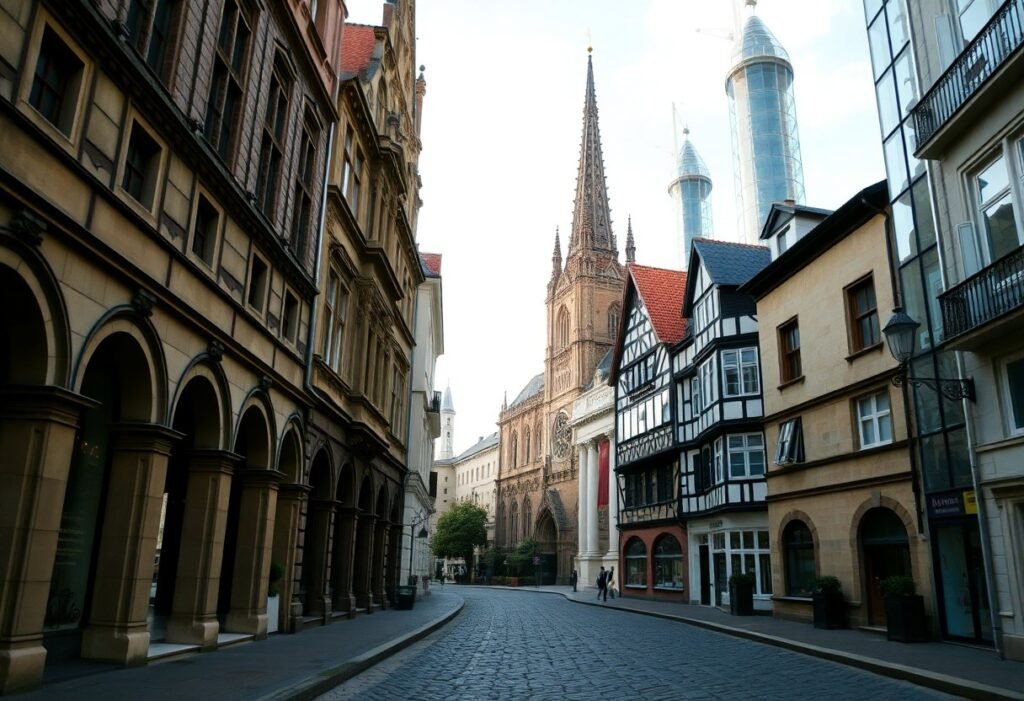
Architecture maps centuries of change across Europe, and you can trace how stylistic evolution-from Roman to contemporary-shaped societies; the most important takeaway is that architecture encodes power, belief, and technology, while heritage is threatened by conflict, neglect, and climate, so your study or visit should balance aesthetics with conservation awareness as you examine Gothic, Renaissance, Baroque, and modernist landmarks.
Key Takeaways:
- Architectural styles across Europe reflect historical layers and regional adaptation-from Romanesque and Gothic to Renaissance, Baroque, Neoclassical, and Modern-shaped by local materials and craftsmanship.
- Cultural, religious, and political forces determined form and function; cathedrals, palaces, civic buildings, and vernacular housing reveal social priorities and power structures.
- Conservation and contemporary intervention balance heritage protection with present-day needs, creating dialogues between historic fabric and new design.
The Foundations of European Architecture
You can see Europe’s technical bedrock in Roman concrete (opus caementicium) and the arch-and-vault systems that made aqueducts and basilicas possible; by the 12th century the Gothic invention of the flying buttress enabled cathedral heights like Notre-Dame de Paris (~96 m) and vaulted spaces previously unattainable. Local stone, timber, and later cast iron shaped regional construction, while proportional systems from Vitruvius guided Renaissance facades. Roman engineering and Gothic structural innovation remain the most enduring legacies.
Historical Influences
You trace stylistic layers across Europe: Roman orders and opus later influenced Renaissance rationalism (15th-16th centuries) while Romanesque solidity (10th-12th c.) preceded Gothic verticality; Byzantine centralized plans like Hagia Sophia (537) informed Orthodox churches, and Ottoman forms reshaped Balkan skylines after the 15th century. The 17th-18th century Baroque expanded theatricality seen in St. Peter’s (1606-1626), and 19th-century historicism revived past vocabularies. Each period repurposed earlier techniques and symbols.
Cultural Contexts
Your regional culture dictated material and ornament: merchant wealth in Venice produced ornate palazzi such as Ca’ d’Oro (15th c.), while Hanseatic trade favored brick Gothic towns in northern Germany and Poland; craft guilds regulated proportions and apprenticeships, and religious patronage commissioned iconography across cathedrals and monasteries. Trade routes and local rituals directly shaped which forms persisted. Patronage and commerce frequently steered stylistic choices.
Beyond patrons, nation-building and industrial change reoriented your urban landscapes: Gothic Revival in Britain (Palace of Westminster, rebuilt 1840s) expressed national identity, Haussmann’s Paris (1853-1870) standardized boulevards, and cast iron and glass (Crystal Palace, 1851) transformed possibilities for light and span. You can still read socio-political shifts in façades, where state projects, colonial ties, and local craft intersect. Industrial materials and state planning altered architectural priorities.
Gothic Architecture
You’ll find Gothic spanning the 12th-16th centuries, marked by verticality, pointed arches and expansive stained-glass schemes that transform light into narrative. For a concise overview linking styles and definitions see 7 Examples & Definitions of European Architectural Styles, while key engineering advances-especially flying buttresses-allowed walls to become vast canvases for glazing.
Key Characteristics
You can spot Gothic by its use of ribbed vaults, clustered piers, and flying buttresses that redirect loads outward, permitting large traceried windows and rose windows. Originating in the 1100s, the style often reaches dramatic heights-Chartres’ nave is about 37 m-while façades function as sculptural programs conveying biblical and civic stories.
Notable Examples
You’ll recognize landmarks like Notre-Dame de Paris (begun 1163, damaged by the 2019 fire), Chartres Cathedral with largely intact 12th-13th century glazing, Cologne Cathedral whose spires reach 157 m, and Milan’s Duomo, a prolonged Gothic enterprise studded with pinnacles and statuary.
When you examine these examples more closely, note construction timelines and conservation: Notre-Dame’s main phase ran through the 12th-14th centuries; Chartres was rebuilt 1194-1220 preserving over 150 medieval windows; Cologne’s campaign stretched from 1248 to 1880; Milan’s Duomo began in 1386 and still required large-scale restoration. Many are UNESCO-listed and active preservation projects, so you’ll see ongoing interventions balancing authenticity and structural safety.
Renaissance Architecture
Renaissance architecture restored classical balance across Europe during the 15th-17th centuries, favoring measured ornament, clear geometry and a revival of Roman orders; you can trace this in urban palaces and church façades where proportion governs layout and human scale replaces Gothic verticality.
Principles and Innovations
Building on Vitruvian theory and Alberti’s writings, architects formalized symmetry and proportion, modular bays, semicircular arches and pilasters; you see technical leaps such as Brunelleschi’s double-shell dome (completed 1436), which used a herringbone brick pattern and novel hoisting machines to span large spaces without full centering.
Major Landmarks
You encounter signature works like Brunelleschi’s Florence Cathedral dome (Santa Maria del Fiore), Bramante’s Tempietto, Michelangelo’s interventions at St. Peter’s and Palladio’s Villa Rotonda; these landmarks established formal vocabularies that spread from Italy to France, England and beyond.
Florence’s dome spans 45.5 m and demonstrated practical engineering solutions; you can trace St. Peter’s (consecrated 1626) as a layered collaboration among Bramante, Michelangelo and Bernini, while Palladio’s villas-codified in his 1570 treatise-set proportions and plans you still recognize in European country houses.
Baroque and Neoclassical Styles
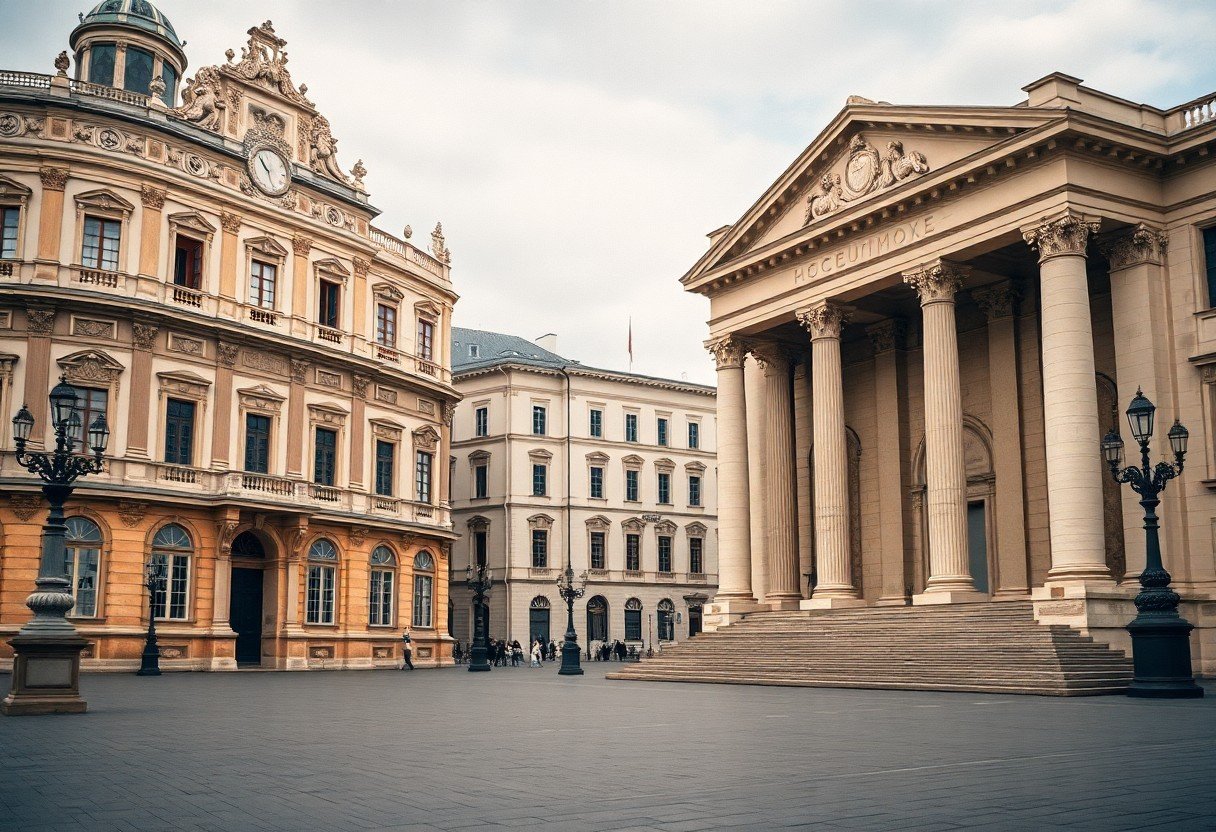
You encounter Baroque’s 17th-18th-century drama in dynamic façades and bold spatial sequences, while Neoclassical (c.1750-1850) restores Greco‑Roman order and civic scale. Study Borromini’s San Carlo alle Quattro Fontane (1638-41) and Versailles’ Hall of Mirrors as Baroque exemplars; compare the Panthéon in Paris (completed 1790) and the British Museum as Neoclassical. For broader context see European Architecture Style: An Overview.
Defining Features
When you inspect details, Baroque emphasizes curving plans, dramatic chiaroscuro, and lavish stucco and gilding-oval naves, twisted columns and sweeping ceiling frescoes create movement. Neoclassical replies with strict symmetry, Greek orders, pediments and restrained ornament, favoring stone, marble and measured proportions influenced by Palladio; domes and temple-fronts signal public authority rather than theatrical spectacle.
Evolution of Style
Political and intellectual shifts drove the change: Baroque grew from Counter‑Reformation commissions (17th century) to assert Church power, while Enlightenment ideals after 1750 pushed you toward classical restraint, producing Neoclassicism by the late 18th century and civic prominence around 1800.
Archaeological finds at Herculaneum and Pompeii in the mid‑18th century directly inspired architects such as Soufflot, Robert Adam and Ledoux to adopt ancient motifs; after 1789 the French Revolution and later nation‑building projects used Neoclassical language for republican identity, and by 1793 buildings like the US Capitol echoed that shift. Be aware that classical vocabulary was also politically appropriated, a dangerous reuse of antique symbolism by various regimes.
Modern and Contemporary Architecture
By the 20th century you see a decisive shift toward functionality and experimentation: Bauhaus (1919), the International Style of the 1920s-30s, and later Brutalism, High‑Tech and Deconstructivism transformed urban horizons. Examples like Mies’s Barcelona Pavilion (1929), the Centre Pompidou (1977) and Gehry’s Guggenheim Bilbao (1997) show how innovation in materials and engineering drove form, while large glazed façades introduced energy and bird-collision challenges.
Emergence of New Styles
You can trace modern movements to Bauhaus (1919) and Le Corbusier’s interwar manifestos; postwar rebuilding sparked Brutalism (1950s-70s) with exposed concrete; the 1970s brought High‑Tech, exemplified by the Centre Pompidou (1977); and digital tools after 2000 enabled parametric design, visible in Zaha Hadid’s MAXXI (2010). These shifts were driven by your changing technologies, materials and urban demands.
Influential Architects
When you study individuals, Le Corbusier (Villa Savoye, 1929) and Mies van der Rohe (Farnsworth House, 1951) define Modernist clarity, while Renzo Piano and Richard Rogers made High‑Tech public in the Centre Pompidou (1977). Zaha Hadid and Frank Gehry pushed form into dynamism; Norman Foster integrated sustainability at scale. Note the Pritzker Prize often marks these leaders’ international recognition.
You can examine case studies: Le Corbusier’s Five Points reshaped housing; Mies’s minimal structure influenced glass-and-steel towers; Gehry’s Bilbao effect (1997) shows cultural investment driving tourism; Foster’s Reichstag renovation (1999) demonstrates how transparency and sustainability can revive institutions. Several architects-Hadid (Pritzker 2004), Gehry (Pritzker 1989), Piano (Pritzker 1998)-offer models for how design reshapes cities and your experience of public space.
Regional Variations in Architectural Styles
You’ll notice regional variation emerges from climate, materials and political history: northern zones favor robust stone and steep roofs to shed snow, while southern areas exploit lime plaster, courtyards and shaded loggias for heat management; coastal trading hubs blend external influences, producing hybrid forms where you can trace trade routes, seismic adaptation and local guild techniques in building height, ornament and plan.
Northern vs. Southern Europe
You can see the divide in structural choices: the north often achieves verticality with Gothic cathedrals (nave heights frequently 30-45 m) and brick façades, whereas the south emphasizes horizontal rhythms, thick sun‑buffering walls and open courtyards found in Renaissance palazzi and Mediterranean villas; seasonal precipitation, insulation needs and material availability shape roof pitch, wall massing and fenestration patterns.
Case Studies of Local Styles
You’ll find concentrated examples that reveal local logic: Venetian Gothic mixes Byzantine masonry and pointed arches, Andalusian architecture fuses Islamic courtyards with later Christian reuse, and Scandinavian stave churches show timber craftsmanship-the dates, construction spans and surviving counts tell the story as clearly as ornament.
- Doge’s Palace (Venice): major Gothic phases c. 1340-1424, façade ~70 m long, built on timber foundations beneath lagoon sediments.
- Alhambra (Granada): Nasrid palaces 13th-14th centuries, complex expanded over ~200 years, UNESCO site since 1984.
- Sagrada Família (Barcelona): construction begun 1882, ongoing >140 years, combines Gaudí engineering with evolving technologies.
- St. Vitus Cathedral (Prague): cornerstone 1344, largely completed 1929, Gothic nave heights ~33 m and lengthy multi‑century build.
- Norwegian stave churches: medieval timber typology, ~28 original examples survive, demonstrating long‑span wooden joinery.
- Neuschwanstein (Bavaria): built 1869-1886 as a 19th‑century reinterpretation of medieval forms, influential for historicist fantasies.
You should read these case studies not as isolated monuments but as data points: construction spans (from decades to centuries), surviving counts (e.g., ~28 stave churches), and measurable heights or façade lengths reveal adaptation strategies-materials, patronage and technology converge so that a single metric like build duration often correlates with stylistic layering and restoration complexity.
- Doge’s Palace: multi‑century building campaign spanning roughly 600 years of modifications; façade length ≈70 m highlights public‑space scale.
- Alhambra: primary Nasrid phase ~1200s-1300s; palace ensemble expanded over ~200 years, illustrating patronage continuity.
- Sagrada Família: begun 1882, >140 years in progress-shows how phased funding and evolving engineering affect program and silhouette.
- St. Vitus Cathedral: construction span ~585 years (1344-1929), demonstrating interrupted Gothic projects tied to political shifts.
- Norwegian stave churches: ~28 surviving medieval examples, indicating regional preservation patterns for timber architecture.
- Neuschwanstein: erected 1869-1886, reflecting 19th‑century historicism and the role of royal patronage in stylistic revival.
Final Words
Presently you can deepen your appreciation of Europe’s varied architecture by observing local materials, ornament, and spatial patterns; your study will be guided by comparative reading and site visits, and you can start with the Beginner’s Guide to Identifying European Architecture Styles to build practical identification skills that make each building’s history clearer and more rewarding.
